Company
Build more ideas before the solver.
Reyn builds software that helps engineers test options before committing each candidate to an expensive solve. Fluid dynamics is our first application; the long-term scope extends across computation-heavy engineering.
Keep full simulation for the designs that earn it.
Engineering teams make better decisions when they can compare a wide set of geometries early. In practice, most ideas never get tested because each geometry change requires remeshing, solver queue time, and manual post-processing.
Reyn places a local neural screening step ahead of that solve. Every model declares where it applies, records how its output was produced, and hands shortlisted candidates cleanly to your existing solver.
Built from solver data, Rust desktop tooling, and open benchmarks.
Reyn was founded by Hamza Iraqi Houssaini to close the
gap between research neural operators and real CAD-to-solver
workflows. Rather than shipping a cloud black box, Reyn combines
PyTorch operator research with a native Rust and wgpu
desktop application that runs directly on an engineer's workstation.
- Founder
- Hamza Iraqi Houssaini (operating from Morocco prior to incorporation)
- Technical stack
- Local Rust +
wgpudesktop workspace paired with signed neural-operator bundles - Ecosystem
- Member of the NVIDIA Inception program for deep-learning startups
- Direct contact
- support@reynflow.com
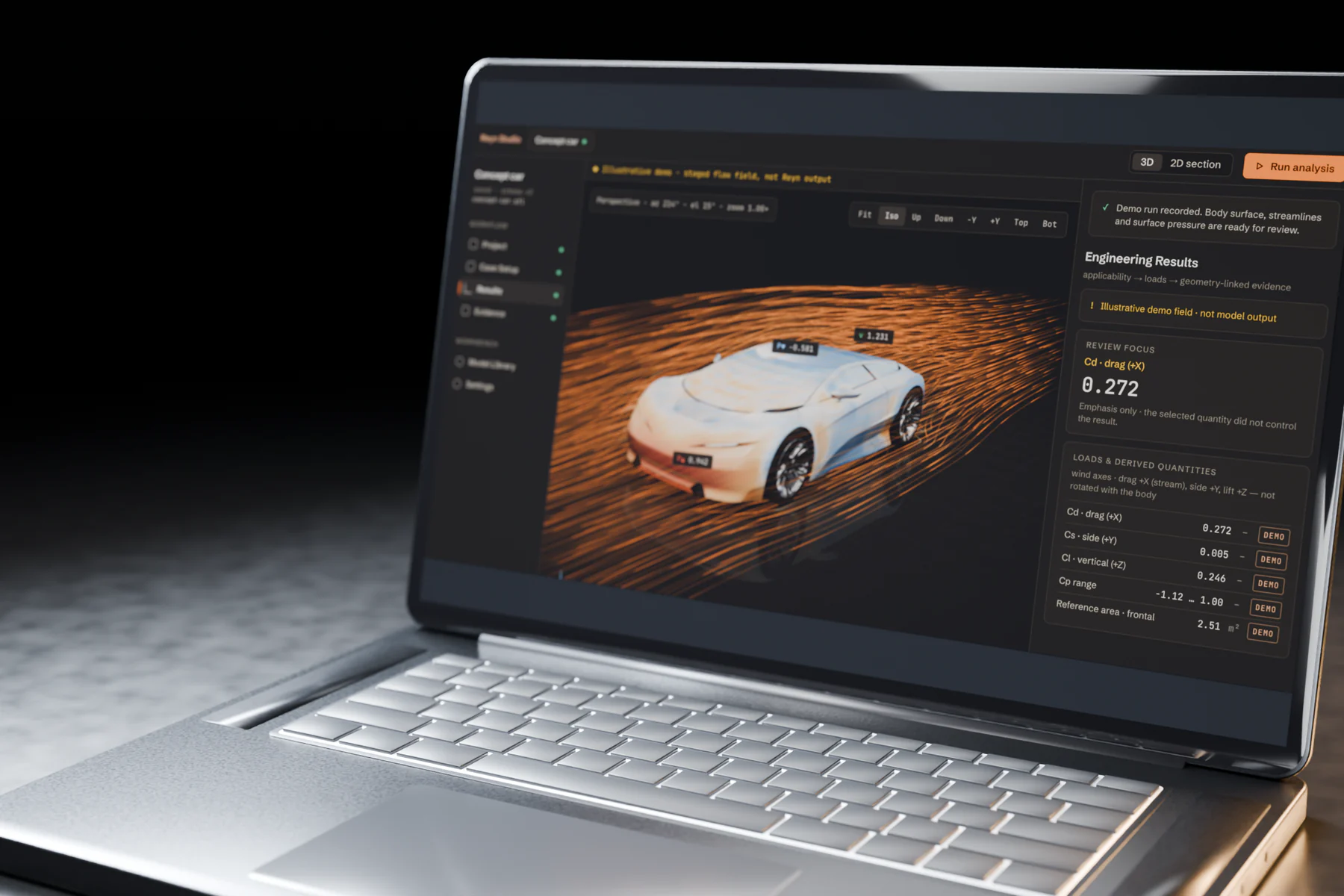
Reyn Studio starts with external fluid flow.
Studio keeps STL geometry, case settings, model identity, derived loads, warnings, and exports inside one portable local project. Version 0.4.1 focuses on fixed-body incompressible external flow.
Where the company is headed.
Fluid simulation is the only domain with a Reyn product today. Over time, the same bounded-screening architecture applies wherever solver cost bottlenecks design iteration.
| Engineering domain | Decisions shaped by computation | Current status |
|---|---|---|
| Fluid systems | External shape, flow behavior, surface pressure, and fluid loads | Reyn Studio 0.4.1 preview |
| Structures | Geometry, load paths, materials, and failure margins | Future direction |
| Thermal systems | Cooling layouts, heat paths, and operating envelopes | Future direction |
| Electromagnetics | Field behavior, geometry, and component tradeoffs | Future direction |
| Process and manufacturing | Operating conditions, throughput, and process windows | Future direction |
| Multidisciplinary systems | Coupled tradeoffs across fluid, structural, and thermal physics | Long-term direction |
Research becomes useful only when it survives the workflow.
- 1.
Find a repeated computational bottleneck
Start where engineers already have trusted simulations but cannot afford to evaluate every useful option.
- 2.
Build a bounded model
Train for a declared problem, operating range, geometry space, and output so unsupported cases stop at preflight.
- 3.
Turn it into a local engineering workspace
Connect every estimate to source geometry bytes, case settings, model identity, warnings, comparisons, and exports.
- 4.
Keep independent validation in the decision
Use fast estimates to choose what deserves full simulation, physical testing, and qualified engineering review.
Talk through a concrete simulation bottleneck.
Share the domain, the repeated solve, and the decision it shapes. We will tell you directly whether it matches Reyn Studio today or our active research.