Compare more designs before the solver queue.
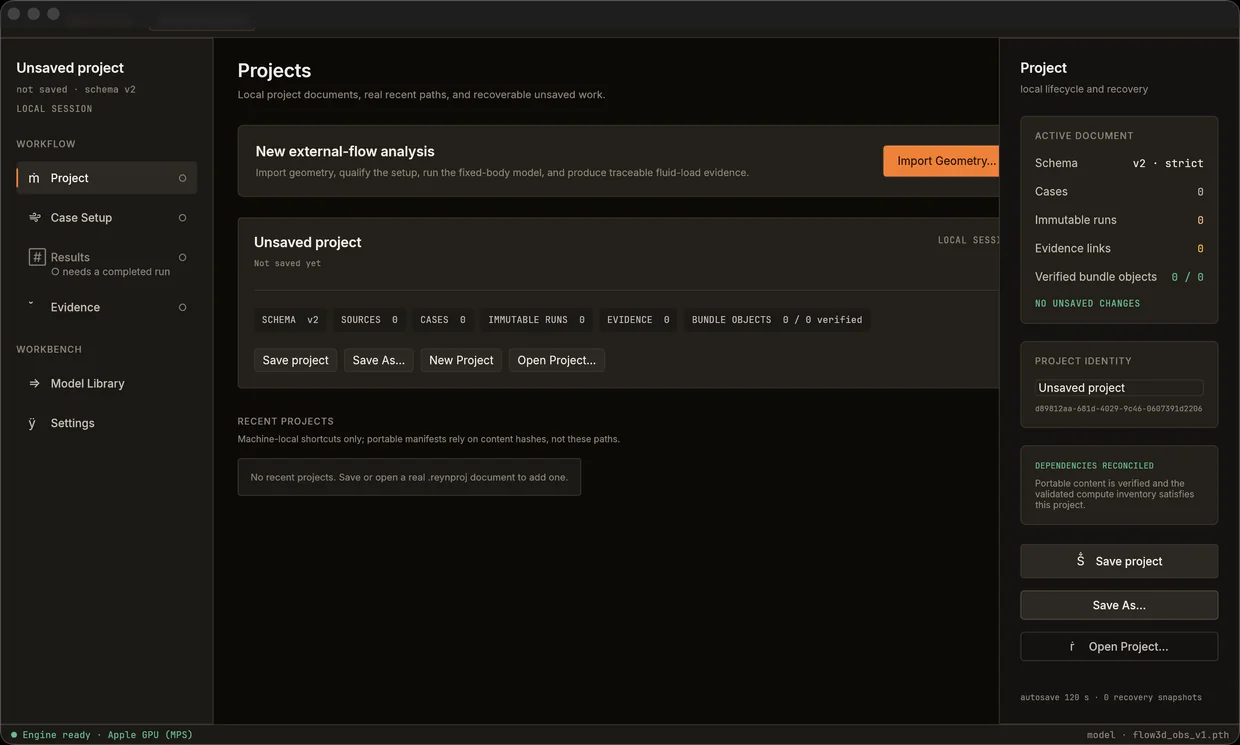
Reyn Studio is local neural CFD for supported external-flow cases. Conventional CFD iteration can spend minutes or hours on meshing and solver waits. The product target is near-interactive feedback on those cases, so teams can screen STL variants before high-fidelity validation in Fluent, STAR-CCM+, or OpenFOAM.
Product target, not a measured end-to-end speedup. The bundled H64 model is authenticated and research-replicated, not production-qualified.
Keep fidelity where it matters. Cut waiting from the first pass.
Reyn is not a replacement for a high-fidelity solver. It is a narrower screening loop for cases covered by a qualified model.
Prepare geometry, mesh, solve, post-process, change the design, then repeat. The wait can run from minutes to hours depending on the case and hardware.
Set up a supported case once, predict it, compare variants, inspect Cp and fluid loads, export the evidence, then validate the designs that survive.
- 01Set up once
- 02Predict a supported case
- 03Compare a variant
- 04Inspect Cp and fluid loads
- 05Export the evidence
- 06Validate with a solver
Setup and evidence in one local project.
Geometry review works without a model. Prediction stays blocked until the exact case has a compatible, qualified model bundle.
From first setup to solver validation.
- 01
Set up the case once
Import an STL, confirm units and orientation, clear preflight, then record the fluid, speed, reference length, and horizon.
- 02
Predict only when supported
Reyn checks the model dimension, grid, contract, channels, horizon, and operating envelope before it creates an immutable run.
- 03
Compare, then inspect
Create a parented variant and review shared-scale fields, Cp, model-derived fluid loads, hotspots, warnings, and applicability.
- 04
Export, then validate
Carry the source, case, run, model, units, and limitations into the handoff. Validate selected designs with a high-fidelity solver.
What Reyn Studio supports today.
This boundary describes the current 0.4.1 research preview. It does not define Reyn's permanent company scope or its future products.
- Flow path
- External flow around one fixed body
- Geometry
- Closed STL with declared units, scale, and orientation
- Current physics
- Single-phase incompressible flow inside the model contract
- Outside today's contract
- Internal flow, moving bodies, thermal, compressible, combustion, and multiphase cases
- Engineering use
- Screening before full solver validation
What people usually ask.
- What is Reyn Studio?
- Reyn Studio is a local neural CFD desktop for screening supported external-flow cases. Import a closed STL, inspect model-derived Cp and fluid loads, then validate selected designs in a full solver.
- Does Reyn Studio replace Fluent, STAR-CCM+, or OpenFOAM?
- No. Reyn Studio is a narrower screening loop for cases inside its declared contract. Full simulation, testing, and qualified engineering review remain in consequential decisions.
- What flow can Reyn Studio screen today?
- Low-speed incompressible external flow around one fixed body, on a closed STL, inside the current model contract. Internal flow, wheels, thermal, compressible, transonic, VOF, and k-ε RANS are out of scope.
- How do I get Reyn Studio?
- Download the Apple-silicon macOS, Windows 11 x64, or Ubuntu 24.04 preview from reynflow.com/beta-access. The app still requires approved credentials and is a research preview, not production-qualified CFD.
Measured in 2D research. Not a Studio speed claim.
In the July 9, 2026 held-out multi-shape study, a 2D model trained on 96 geometries improved relative L2 error by 5.6× over the earlier 64-cylinder model and reported a 15× margin over persistence across the tested horizon ladder.
Those figures describe one named research artifact, obstacle_v2_shapes.pth. They do not establish end-to-end product latency, a production speedup, or qualification of a 3D Studio model.
Read the study and method →Download the current beta.
Version 0.4.1 is public to download. The app still requires approved credentials, and it is not production-qualified CFD.
Choose a download