Bring a shape.
Import a closed STL and confirm units and orientation. Studio checks the geometry and the case before anything runs, and stops if it cannot stand behind the answer.
concept-car.stl100,741 triangles4.36 × 2.34 × 1.15 m
Reyn Studio 0.4.1 preview
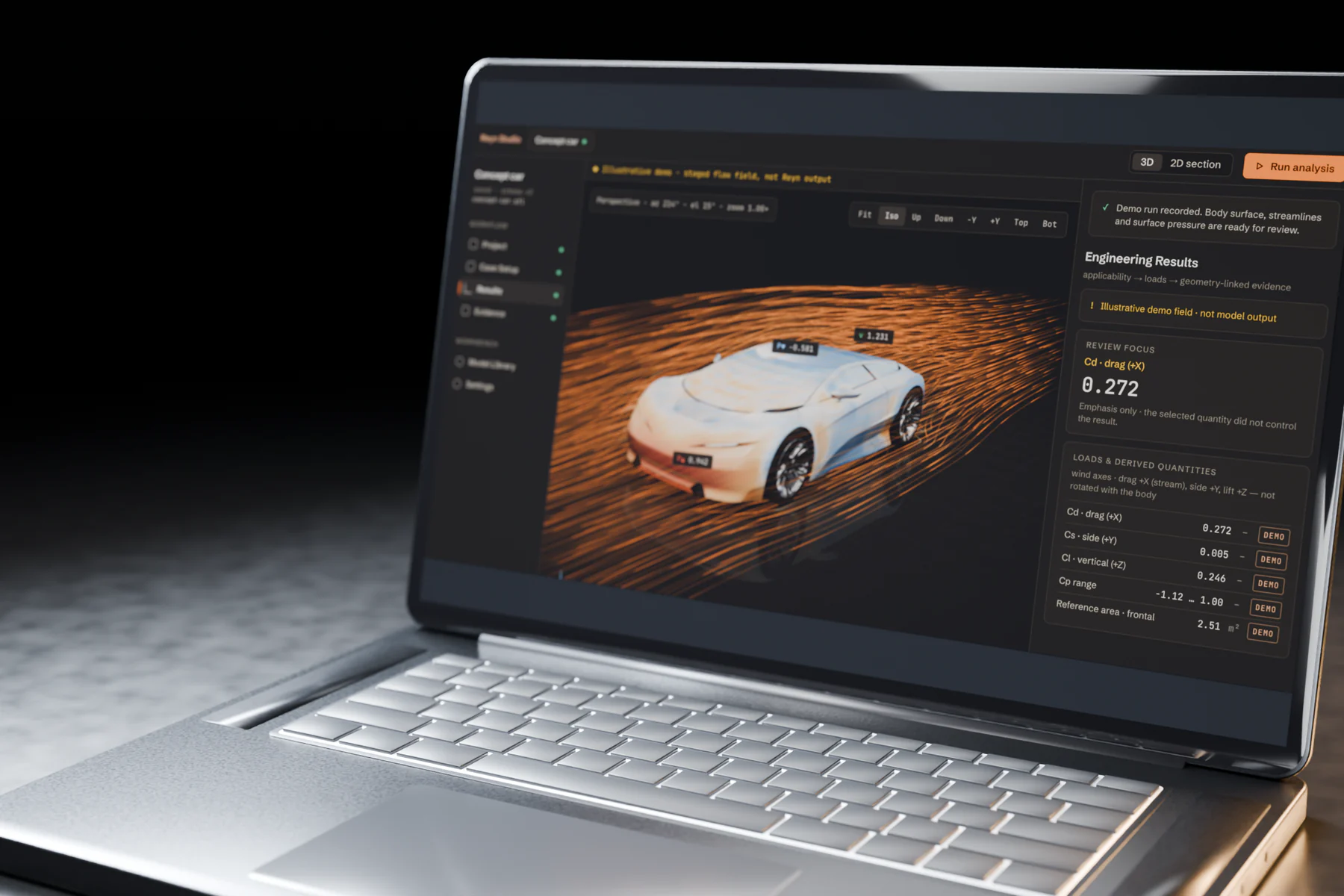
Reyn Studio is a desktop app for neural CFD. Import a shape and a learned model predicts the flow around it in one pass, on your own machine. Today it screens candidate designs before a full solver run, on the path toward replacing the solve.


Import a closed STL and confirm units and orientation. Studio checks the geometry and the case before anything runs, and stops if it cannot stand behind the answer.
concept-car.stl100,741 triangles4.36 × 2.34 × 1.15 m
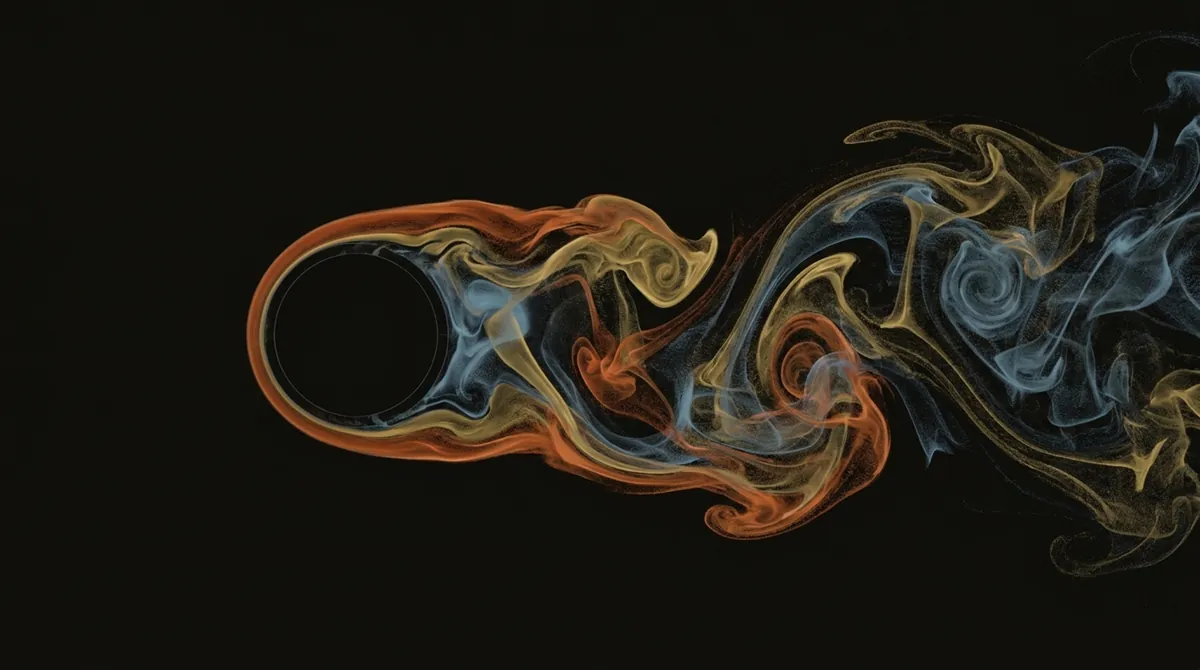
The usual route meshes the domain, then steps toward the answer a little at a time. Keep scrolling. Every notch is another round of waiting, for one design. Every step is another round of waiting, for one design.
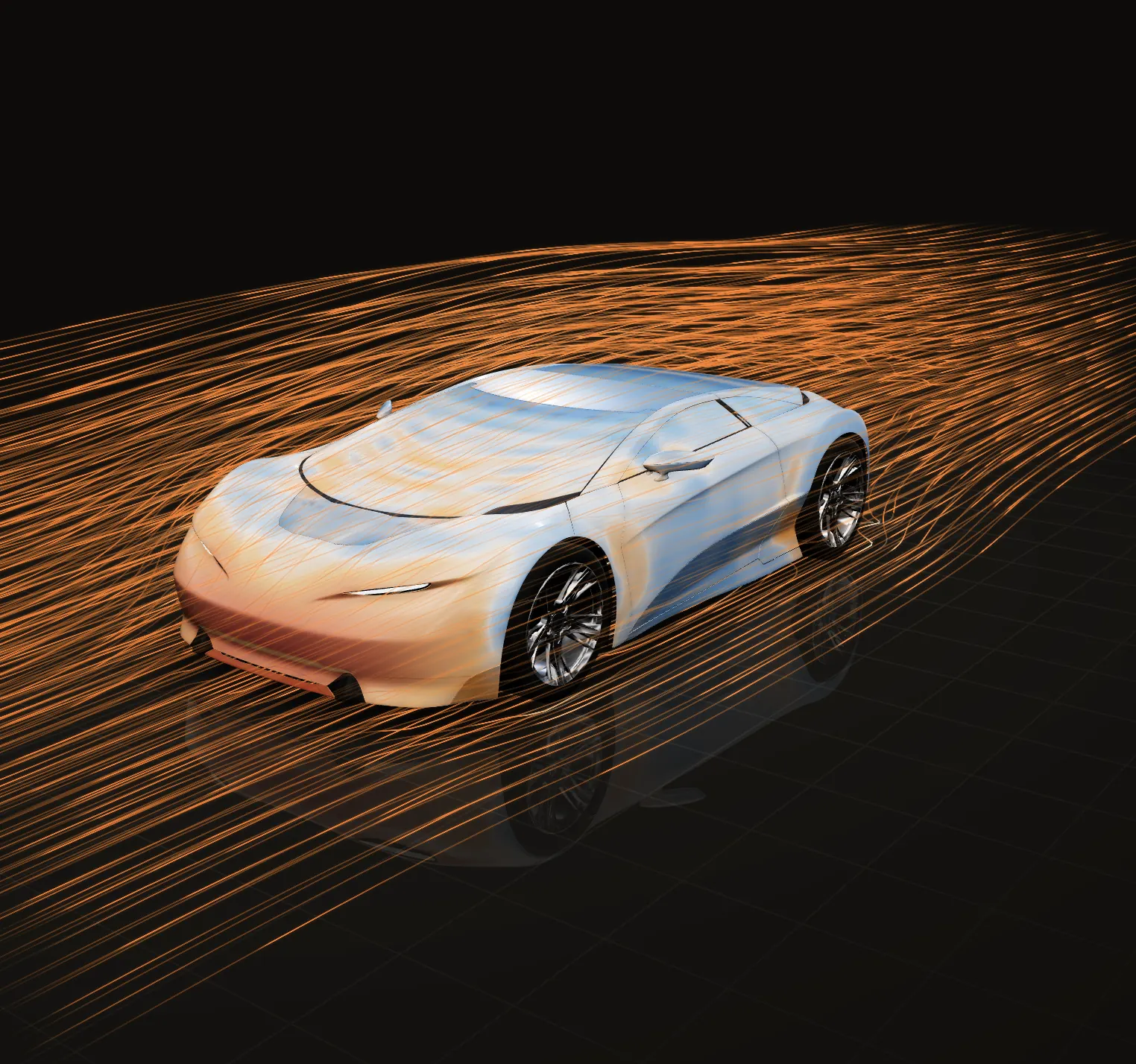
A neural operator trained on solver data predicts the developed flow directly. No marching: one forward pass, whatever the horizon.
≈35 ms per model call at research scale. What that number measures
Surface pressure, forces and coefficients arrive with the field, each one labelled with where it came from. Keep the ones worth a full solve.
Geometry: “Car Concept”, © 2024 Darmstadt Graphics Group GmbH, CC BY 4.0, simplified; NASA X-57 Maxwell, public domain (NASA 3D Resources), simplified. See recorded Reyn output
Reyn Studio predicts supported external-flow cases on your own machine and shows which designs deserve a full solve. Your solver stays in the loop.
What Studio does todayA neural solver accurate and accountable enough to replace the solve. We publish how far along that is, including where it fails.
Read the researchWhen every geometry change demands a fresh mesh and queue slot, most variants never get tested. Screen twelve candidates on your desk, rank the family, and commit full CFD only to the shapes that earn it.
Four workspaces carry an external-flow case from raw STL bytes and preflight checks to predicted loads and an immutable run record.
Create a project and import an STL. Studio records the source bytes and their SHA-256, then asks you to confirm units, scale and orientation.
Set the fluid, the speed and the reference length. Preflight reviews topology, voxel thickness and boundary clearance. Studio does not silently repair the source, and it blocks a case the model cannot support.
Inspect the predicted field, surface pressure and model-derived loads in 3D or as a section. Compare a variant against its parent.
Every run is immutable: source, case revision, model identity, settings and warnings. Export it, then validate the designs worth keeping in a full solver.
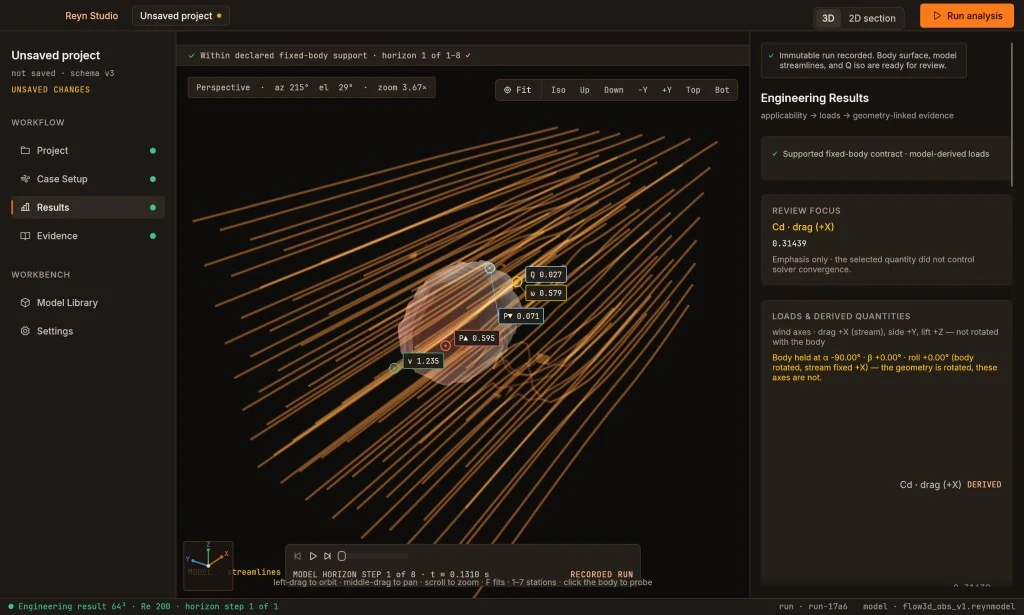
The model maps the starting state to the developed flow in a single evaluation. Extending the prediction horizon changes the target window rather than multiplying solver time steps.
Preflight gate, Studio 0.4.1
Preflight checks topology, voxel thickness, and boundary clearance before the model runs. Out-of-contract shapes stop at the gate with an explicit diagnostic.
Every number carries its source: the geometry hash, the model identity, and the limits it ran under. Every exported CSV and report links back to the exact input bytes and model bundle.
Six test shapes run through the research operator that ships in Studio: four produced a flow field, and two were refused at preflight with the exact voxel diagnostic.
Section drawing (enable WebGL and motion for 3D)
1.044 m · R100 nose · 25° slant
Model-derived loads: pressure is recovered from the predicted velocity field.
1.04 m · 25° rear slant
Model-derived loads: pressure is recovered from the predicted velocity field.
Ø80 × 260 mm
Model-derived loads: pressure is recovered from the predicted velocity field.
1.30 m · Ø0.30 m
Model-derived loads: pressure is recovered from the predicted velocity field.
Ø60 × 200 mm
Voxelization produced an empty solid: after auto-fit the body is 0.92 cells thick across x on a 32³ grid.
The orange square shows one model cell to scale. Studio halts here rather than extrapolating below grid resolution.
c 120 mm · span 300 mm
Voxelization produced an empty solid: after auto-fit the body is 0.15 cells thick across z on a 32³ grid.
The orange square shows one model cell to scale. Studio halts here rather than extrapolating below grid resolution.
Reyn Studio is a native desktop app with the signed model bundle inside the package. There is no cloud queue to join and nothing to upload: geometry, projects and results stay on your disk.
Apple silicon (arm64)
192.1 MiB ZIP, Ad-hoc signed, not notarized
Windows 11 (x64)
208.8 MiB ZIP, Portable preview, unsigned
Ubuntu 24.04 (x86_64)
239.1 MiB AppImage, CPU-only preview pending desktop verification
All CAD bytes, case revisions, and exported reports remain on local disk with zero geometry upload.
Every model is scored against solver data on geometries it never saw during training, and the failure cases are published alongside the wins.
Today Reyn Studio screens candidate designs while your solver signs off final decisions. Each step toward full solver resolution is benchmarked openly on held-out cases.

A signed research operator on a 32³ grid for one fixed body in low-speed incompressible external flow, screening supported shapes before a full solve.

Finer spatial resolution, thinner bodies, and broader Reynolds regimes, each scored on held-out cases with misses published beside wins.

A neural solver accurate enough to take the full case directly: fine boundary resolution, explicit error bounds, and verifiable run evidence.
Grid-resolution schematic across three spatial scales.
Reyn Studio 0.4.1 is an invitation-only research preview. Tell us what you are designing and we will get you set up.