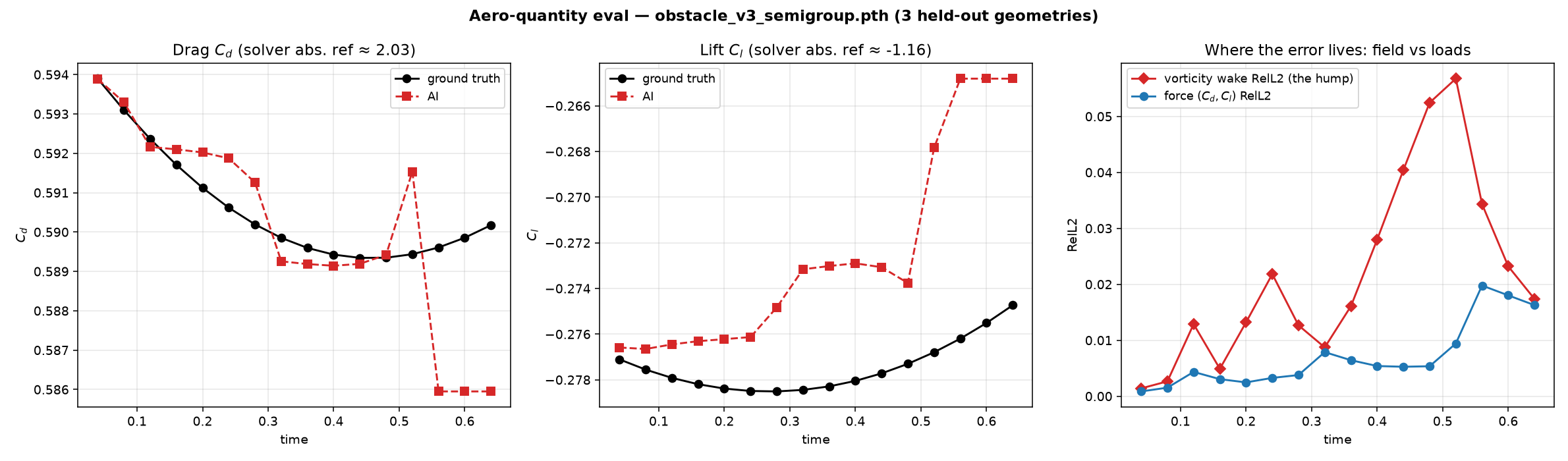
Where field error lives, and why surface loads stay tight.
Even where downstream wake vorticity experiences a mid-horizon phase hump (0.052 RelL2), near-body pressure recovery holds integrated force error at 0.005.
Strouhal lock: St 0.128 = 0.128.
Time-averaged drag can look acceptable even when an operator damps out Karman vortex shedding. Scrub the phase-alignment scope to see how unlocked phase or amplitude error compares against the measured St = 0.128 frequency match.
The Strouhal match (St = 0.128 on both reference solver and learned flow map) is a measured result from the unsteady evaluation above; the interactive oscilloscope renders a clean schematic C_L(t) sinusoid so you can inspect phase-offset sensitivity directly.
Published load & frequency metrics.
All four numbers below come from held-out geometries with zero separate force-regression head: forces are integrated directly from the predicted fluid fields.
- 0.5–1.6%
- Reported load error band between model-derived and solver-derived integrated forces across the horizon ladder.
- 0.001–0.016
- Force Relative L2 range across three held-out geometries spanning Re = 104 to 355.
- 0.128St
- Dimensionless vortex-shedding frequency (f·D/U∞), matching the reference simulation’s 0.128.
- 0.005vs 0.052
- Force RelL2 at the mid-horizon field hump, showing 10× lower sensitivity in surface loads than in far-wake vorticity phase (0.052).
Inspect 24-tap surface Cp(s) and 6-DOF tractions in 3D.
In Reyn Studio’s 3D CAD workflow, pressure is recovered from the predicted
velocity field and integrated via diffuse_interface_traction.v1. Switch across all four cleared 3D
reference bodies and scrub individual perimeter taps.
Coefficients in the 3D Studio inspector above are model-derived fluid diagnostics at Re = 150 on a 32³ grid, rather than high-Reynolds wind-tunnel measurements or internal solid-mechanics stress. Moments are referenced to the diffuse-surface area centroid for relative candidate ranking and downstream FEA load mapping.
Why we forbid separate scalar Cd/Cl shortcuts.
Predicting a single scalar drag number from a point cloud is easy to overfit and impossible for an aero lead to audit physically.
- Field-first derivation
- Every force, moment, and Cp curve is computed from the predicted spatially resolved flow field rather than an ungrounded scalar MLP head.
- Identical operator
- The exact same numerical integration routine processes both the ground-truth solver state and the neural flow-map state, eliminating post-processing bias.
- Inspection parity
- If a drag delta looks surprising between two CAD variants, engineers can immediately slice the centerline Cp(s) taps and wake deficit plane to verify the physical cause.