Research · 3D fields

Measured 3D field error on held-out obstacle cases.

Published 4 Aug 2026 · Updated 21 Aug 2026

Latest study Evaluation 21 Aug 2026

Held-out 3D obstacle-flow map

Published 21 Aug 2026

On 48 held-out 3D obstacle cases at 32³, a one-jump model reaches whole-field RelL2 0.020 / 0.028 / 0.052 at 32 / 64 / 128 steps, versus 0.084 / 0.136 / 0.209 if the initial field is simply held. That is a 4.0× margin at 128 steps. These are research diagnostics, not a production CFD qualification.

One jump. New shapes. Beat “nothing changed.”

Published 21 Aug 2026

The model estimates a later velocity field from the current one in a single jump. That estimate is scored against a full 3D simulation on shapes held out of the test set, on a 32³ Cartesian grid in a periodic box. The required floor is hold last state: copy the initial field forward as if nothing changed.
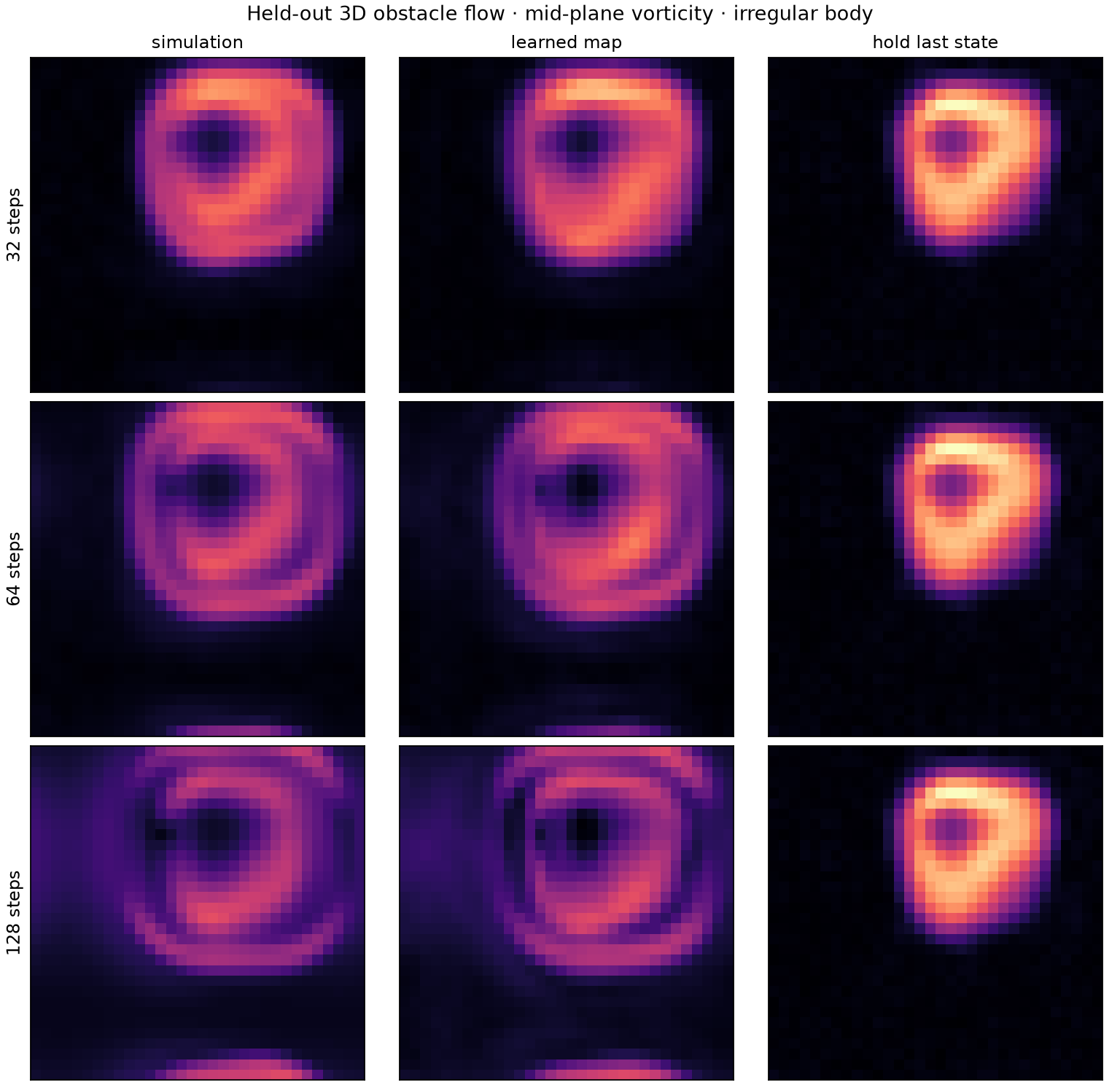
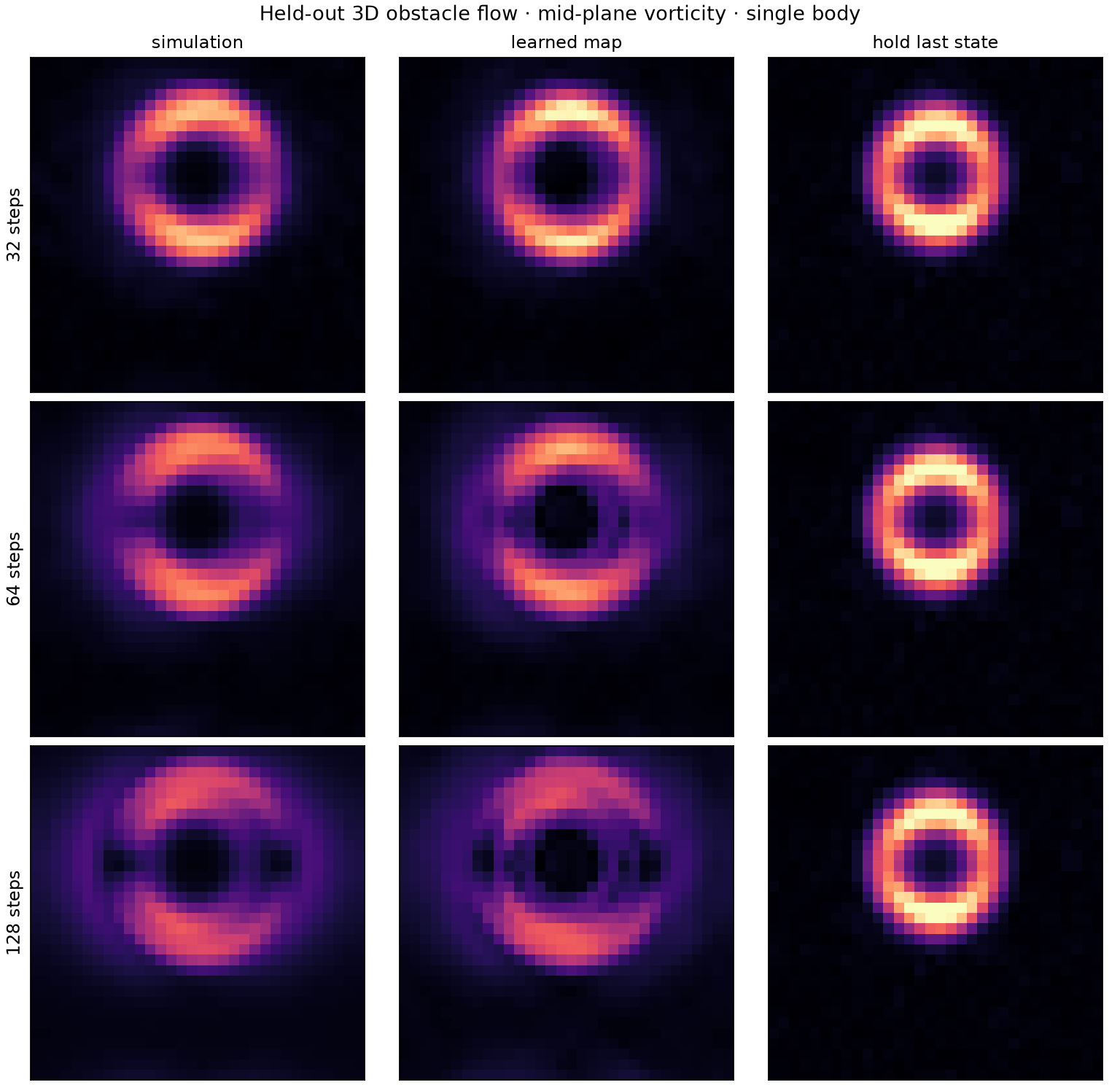
Held-out irregular body: mid-plane vorticity from the simulation, the learned map, and hold last state at 32, 64, and 128 steps
Irregular body · 32³ mid-plane vorticity · simulation, learned map, hold last state
FIG 2.0 Headline numbers

Measured results from the same study.

Published 21 Aug 2026

Whole-field relative L2 on velocity. Occupied cases and empty-box cases are split at 128 steps only.

0.052
relative L2 at 128 steps on the held-out set
4.0×
margin over hold last state at 128 steps
0.020 / 0.028
relative L2 at 32 and 64 steps (hold last state 0.084 / 0.136)
0.062 / 0.003
occupied-case and empty-box means at 128 steps
48
held-out cases on a 32³ periodic box
FIG 3.0 Horizon and families

The gap to hold last state holds across horizons and families.

Published 21 Aug 2026

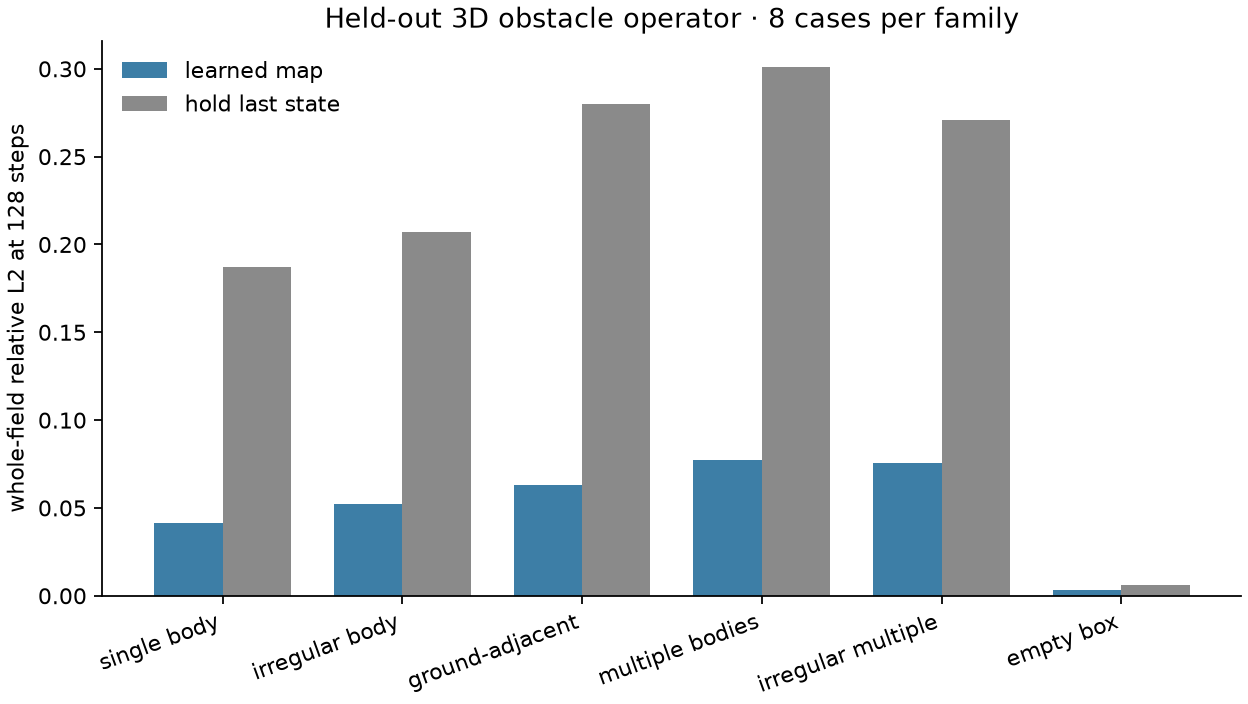
The public chart shows only the learned map and hold last state. Family means at 128 steps are eight cases each.
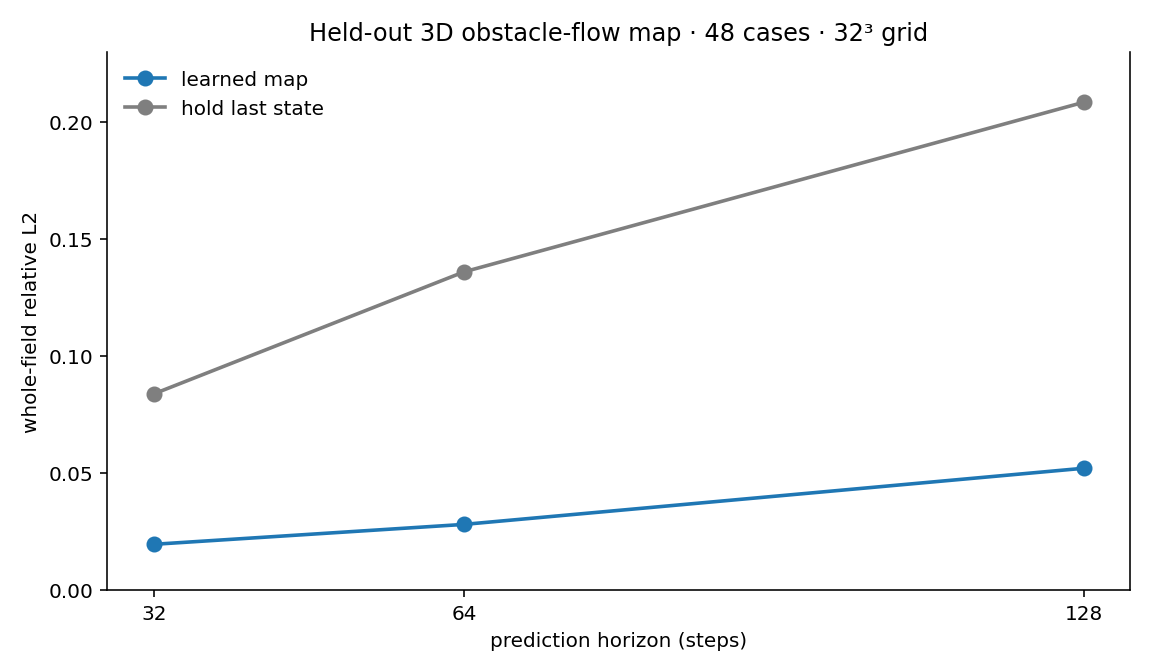
Line chart of whole-field relative L2 versus horizon for the learned map and hold last state
Learned map versus hold last state · 32, 64, and 128 steps · 48 cases
Bar chart of 128-step relative L2 by geometry family for the learned map and hold last state
Family means at 128 steps · eight cases each · learned map versus hold last state
Family means at 128 steps
Family Learned map Hold last state
single body 0.041 0.187
irregular body 0.052 0.207
ground-adjacent 0.063 0.280
multiple bodies 0.077 0.301
irregular multiple 0.076 0.271
empty box 0.003 0.006
FIG 4.0 Inspection

Mid-planes stay coarse. That is the grid.

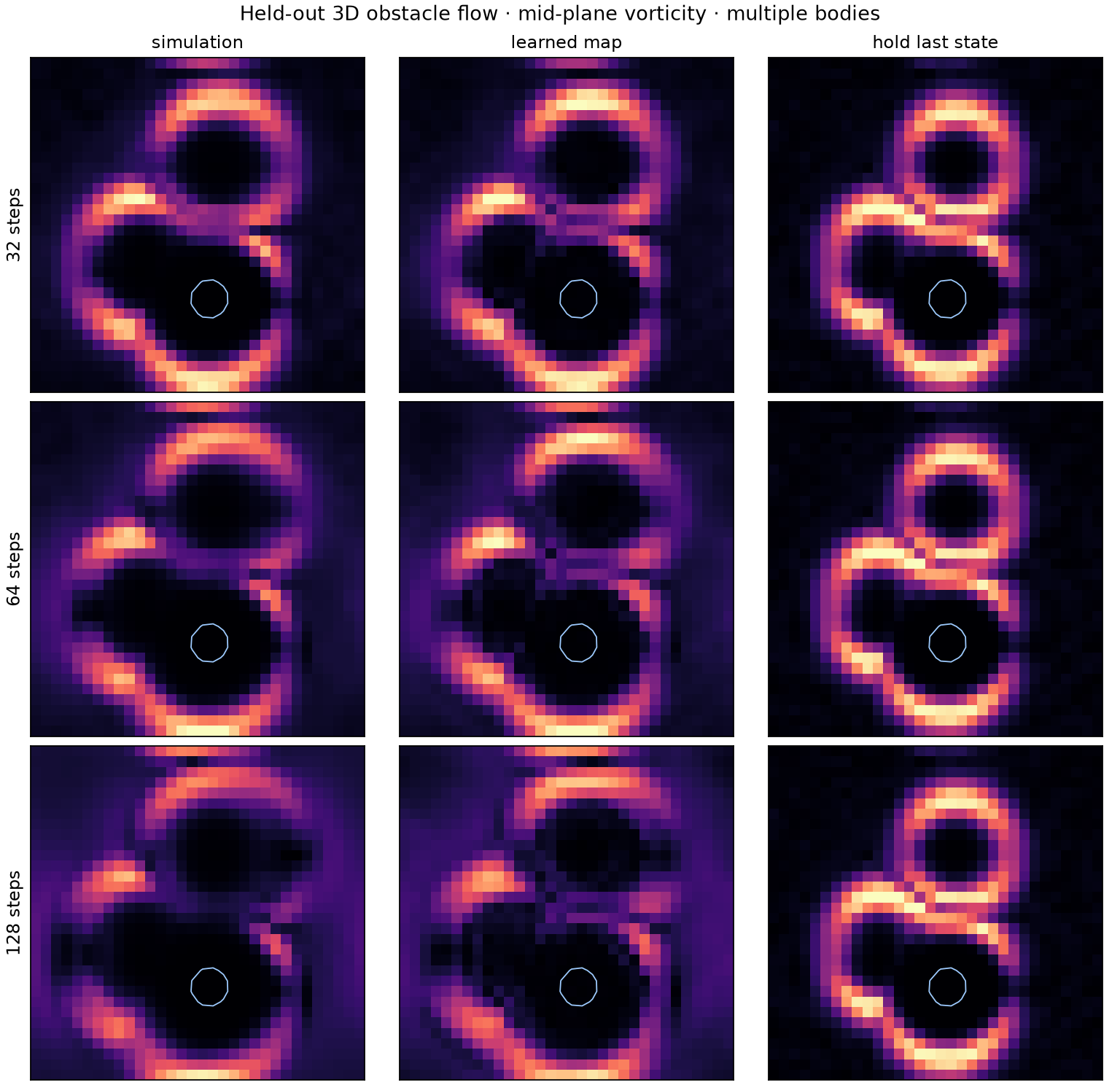
These slices are 32³. They are not upscaled. Orthogonal cuts at 128 steps sit beside single-body and multiple-body comparisons across the same horizons.
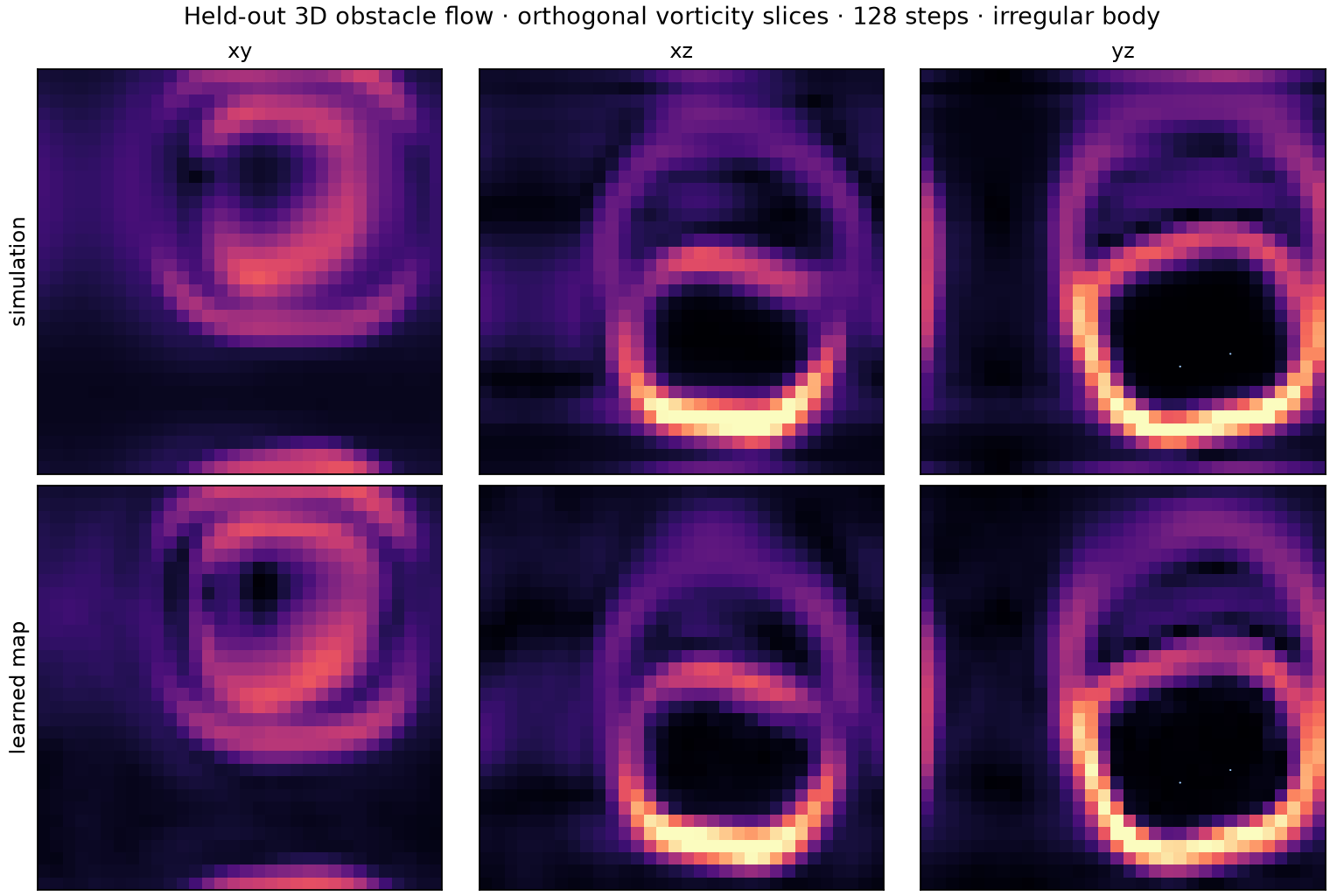
Orthogonal xy, xz, and yz vorticity slices at 128 steps for an irregular body, simulation versus learned map
Irregular body · orthogonal vorticity slices · 128 steps
Single-body mid-plane vorticity comparing simulation, learned map, and hold last state at 32, 64, and 128 steps
Single body · mid-plane vorticity · 32 / 64 / 128 steps
Multiple-bodies mid-plane vorticity comparing simulation, learned map, and hold last state at 32, 64, and 128 steps
Multiple bodies · mid-plane vorticity · 32 / 64 / 128 steps
FIG 5.0 Study limits

What this study does not cover.

Published 21 Aug 2026

This evaluation is 32³, a periodic box, held-out obstacle and empty-box families, velocity RelL2, and a one-jump map to 128 steps. It does not certify Reyn Studio, engineering loads, other physics, or finer grids. RelL2 is a diagnostic, not engineering approval.

Research 3D evidence is the 32³ one-jump obstacle operator (RelL2 0.052 at 128 steps, 32,768 cells). CAD Run voxels the case to that declared grid. It does not resample this operator onto a 64³ field.
Earlier studies

Earlier study Validated 3D research track

Published 9 Jul 2026 · Updated 21 Aug 2026

3D solver and obstacle evaluations

Published 3D research numbers and figures from an earlier protocol. These remain research results, not blanket production qualification. The obstacle RelL2 here is not comparable to the 32³ one-jump study above: different evaluation, grid, and horizon. The later number is not a regression of this one.

3D has solver evidence. Studio keeps the gate.

Published 9 Jul 2026 · Updated 21 Aug 2026

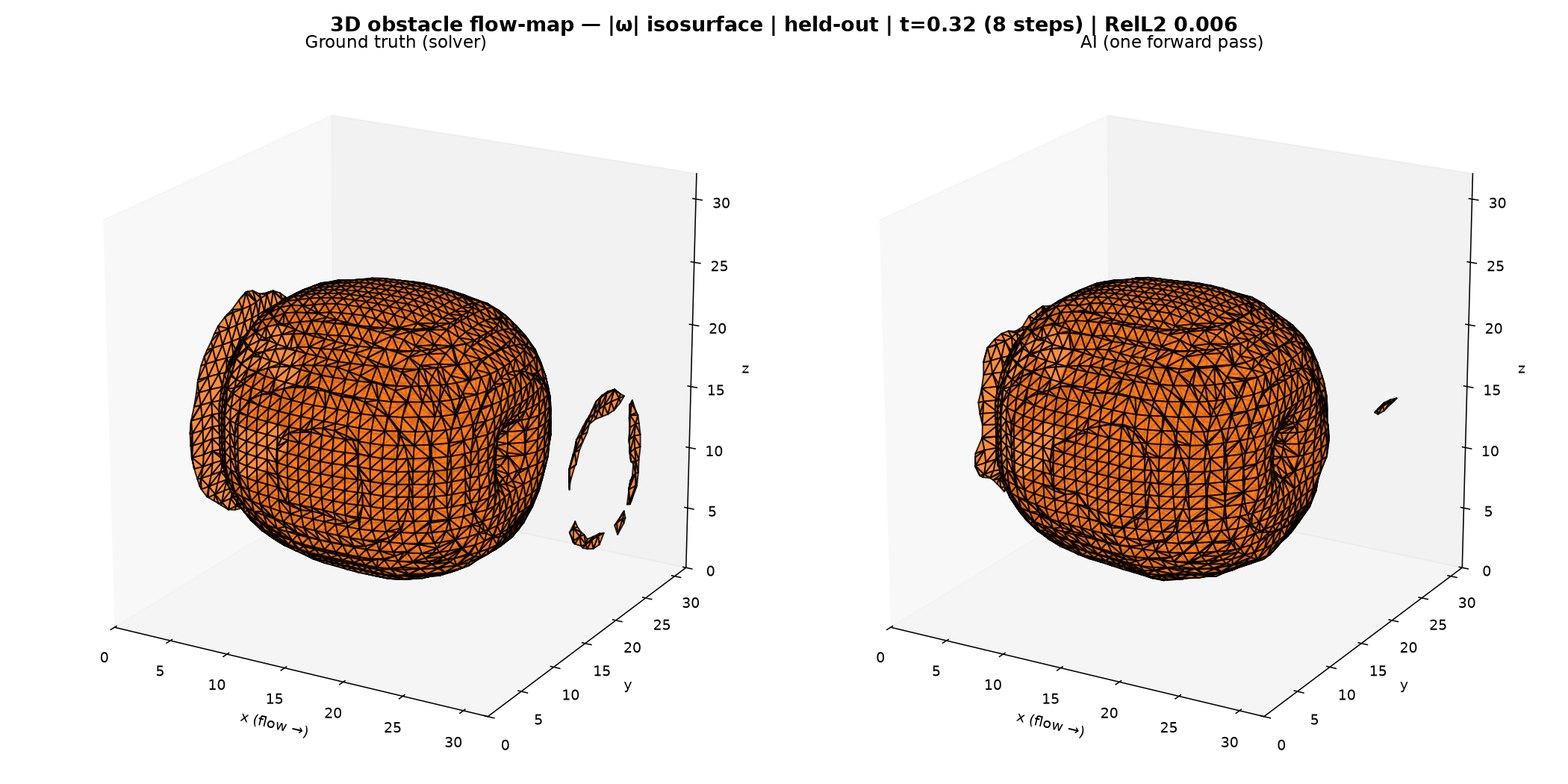
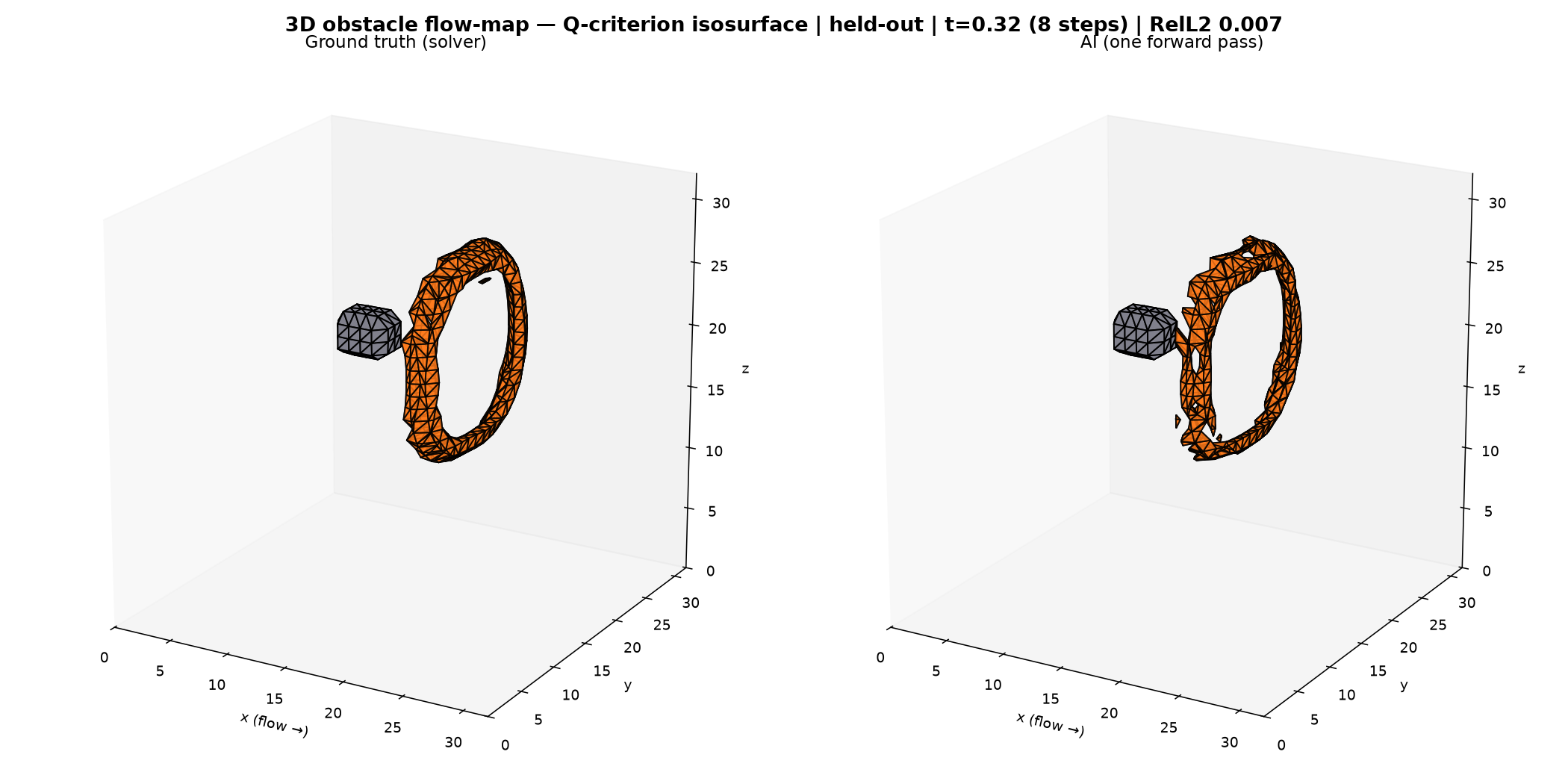
The 3D solver study reached 3.9×10⁻¹⁵ relative L2 in its validation case. Obstacle studies report 0.006–0.007. Reyn Studio exposes 3D paths only when a compatible verified model is present.

Validated three-dimensional vorticity research render
3D vorticity · validated solver research
Earlier three-dimensional obstacle-flow research render
Earlier 3D obstacle case · reported RelL2 0.006–0.007

Limits of these evaluations.

Published 4 Aug 2026 · Updated 21 Aug 2026

These evaluations do not certify Reyn Studio, prove accuracy outside the tested equations and shapes, or qualify every model bundle. Relative L2 and load errors are diagnostics, not engineering approval. Research 3D evidence is the 32³ one-jump obstacle operator (RelL2 0.052 at 128 steps, 32,768 cells). CAD Run voxels each case to the model's declared grid. This hub covers Reyn's published fluid-model research, not the permanent scope of the company.

Request access.

Studio packages are public. Credentials are issued after review. These evaluations do not qualify the desktop preview as production CFD.

Request beta access